Diamond Tools Built for America’s Infrastructure Projects
Premium diamond blades, core bits, and specialty tooling trusted by contractors, municipalities, and heavy civil construction professionals, backed by our founder’s 35+ years in diamond tooling.
Industries We Support
Tooling matched to the way each sector actually works. Choose yours for specifications, failure modes and a recommended kit list.
Featured Products
Diamond Blades
- Asphalt Blades
- Concrete Blades
- Roadway Blades
- Bridge Deck Blades
Core Bits
- Wet Core Bits
- Dry Core Bits
- Heavy Duty Core Bits
Specialty Tooling
- Grinding Tools
- Polishing Pads
- Surface Preparation
Equipment
- Saws
- Accessories
- Attachments
🛡️
35+ Years Founder Experience
Decades of industry expertise you can trust.
💎
Premium Performance
Engineered for maximum cutting speed and long life.
🚚
Fast Delivery
Rapid shipping across the United States.
🎧
Expert Support
Real people. Real answers. Real fast.
The work these tools are built for
Typical jobs our customers run, and the tooling each one calls for.
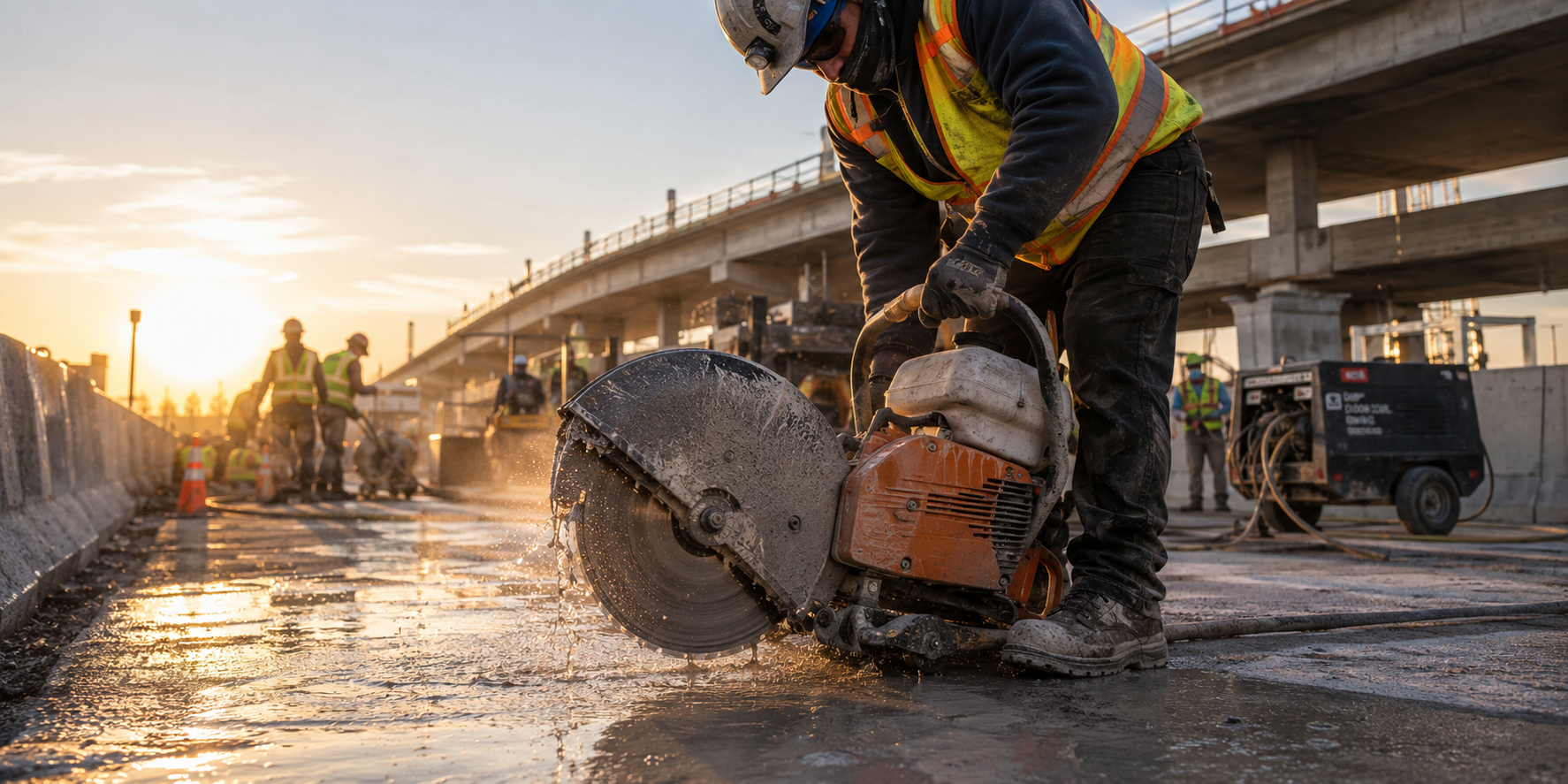
Bridge deck rehabilitation
Partial-depth removal through two mats of reinforcement, followed by full-depth panel replacement.
Typical tooling: Soft-bond segmented blades to 24″, plus wet core bits for scupper and anchor holes.
Bridge contractors →Full-depth pavement repair
Boundary cuts for lane repair inside a timed closure, through ten to twelve inches of pavement.
Typical tooling: Hard-bond blades with undercut protection, 30″ and 36″ on a walk-behind saw.
Highway contractors →Water main replacement
A trench line across live carriageway, then penetrations through chamber and basement walls.
Typical tooling: Hard-bond asphalt blades for the trench, wet core bits from 4″ to 12″ for connections.
Utility contractors →Choosing the right diamond tool
Diamond tooling is bought on one decision that most catalogues never explain: the bond has to be matched to the material, and the rule runs backwards from what people expect. Hard, dense material takes a soft bond. Soft, abrasive material takes a hard bond. Get that the wrong way round and the blade either glazes and stops cutting, or wears out while the diamonds are still sharp.
Everything else follows from four questions. What are you cutting, and in what condition — cured concrete behaves nothing like a green pour, and asphalt is the opposite again. How deep is the cut, which sets diameter, because a blade cuts to about a third of its own diameter. What saw are you running, which sets arbor and horsepower. And can you get water to the cut, which changes both blade life and how you meet silica requirements.
Answer those four and the specification is usually obvious. Guess at them and you buy a blade that fails early and looks like a quality problem when it was a selection problem. That is the whole reason this site is built around technical guides and category buying guides rather than a bare product grid — the tool is easy once the question is clear.
Browse by what you are cutting: concrete, asphalt, masonry and block, tile and porcelain and stone. Or by what you are doing: core drilling, grinding and surface prep, saws and equipment.
Common questions
What diamond blade do I need for cutting concrete?
For hard or cured concrete, a soft-bond segmented blade, sized to your saw and run wet wherever possible. For fresh or green concrete, a harder bond with undercut protection, because green concrete is abrasive and will erode a soft blade before the diamonds have done their work.
Why does hard concrete need a soft bond?
Because the bond has to wear away to keep exposing fresh diamond. In hard, dense material a soft matrix erodes at the rate the aggregate demands, so the blade keeps cutting. A hard bond holds worn diamonds in place, the rim polishes over, and the blade stops cutting — that is glazing, and pressing harder makes it worse.
How deep will a blade cut?
Roughly one third of its diameter. A 14 inch blade cuts a little over four inches. If you need more depth than that, you need a larger machine or a cut from both sides — not more pressure.
Should I cut wet or dry?
Wet whenever the saw allows it. Wet cutting typically gives two to three times the blade life of the same blade run dry, produces a cleaner cut, and controls respirable silica dust. Dry blades are for short cuts where water is impractical, and they should be paired with vacuum dust collection.
What arbor size do I need?
Match it to your saw. Handheld saws are commonly 7/8 inch or 5/8 inch, and high-speed and walk-behind saws often 1 inch or 20mm. Bushings adapt some combinations, but check the saw before ordering rather than after.
Do you supply municipalities and public agencies?
Yes. We supply public works departments, highway and bridge crews, utility contractors and heavy civil operators, and we are used to quoting against a written specification. If you have a line item you need matched, send it and we will tell you exactly what it specifies.
Still not sure? Tell us what you are cutting and the saw you are running and you will get an answer from someone who has specified the tool before, not a catalogue link.
Ready to Improve Productivity on Your Next Project?
Get the right tools, expert support, and construction solutions that keep your projects on time and on budget.