
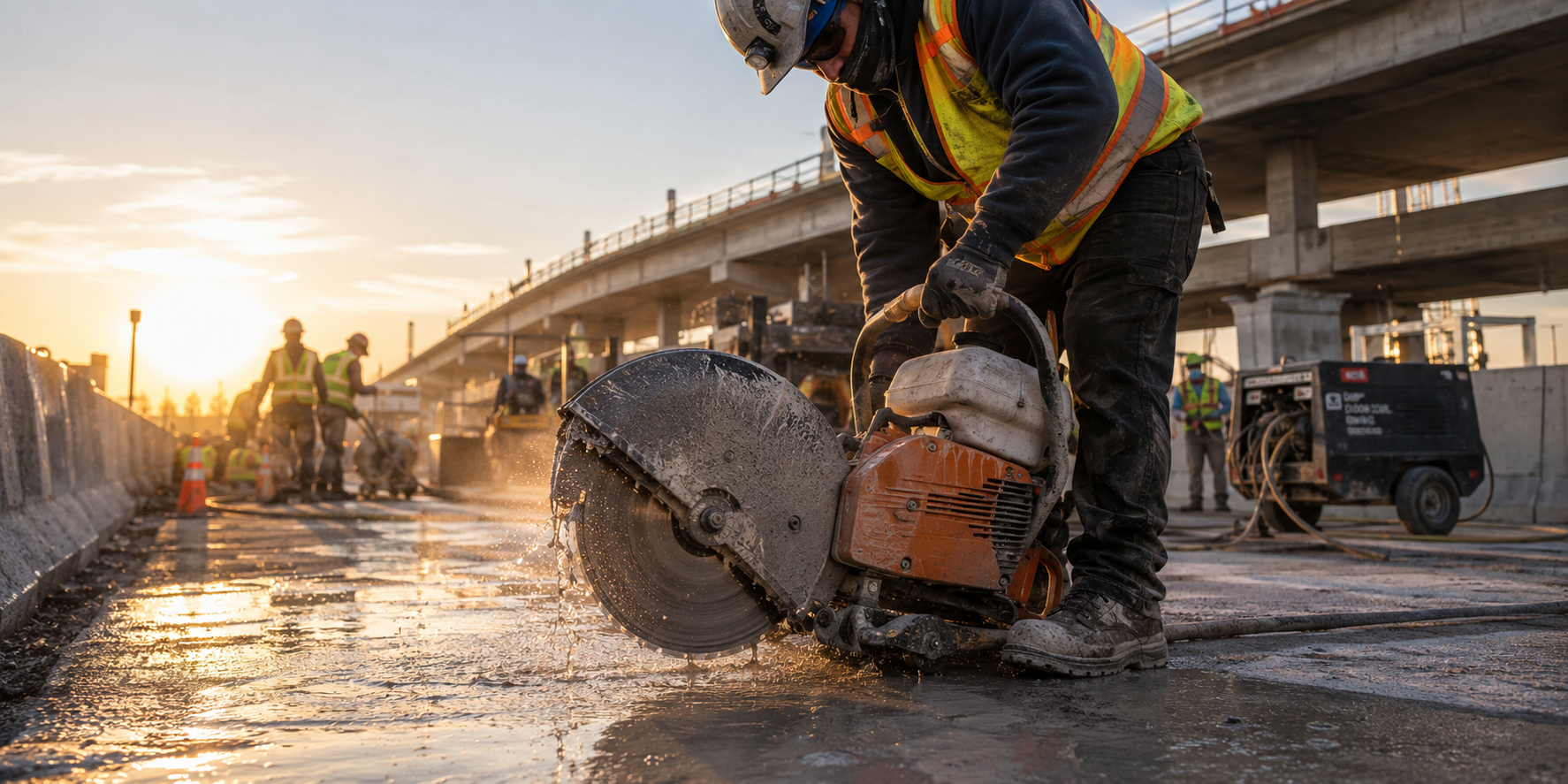
Diamond Tools for Industrial Contractors
Hardened plant floors, equipment pads and anchor coring, all of it inside a shutdown window that does not move. Reliability matters more than headline cutting speed.
The outage window is the real specification
Industrial work is scheduled around production, not around the contractor. A plant shutdown is costed in lost output per hour, so the penalty for a stalled saw or a wrong blade is measured in a completely different currency from a normal construction delay.
That changes buying behavior. Carry spares of anything on the critical path, favor a specification you have used before over a marginal gain, and confirm consumables are correct before mobilising rather than on the morning. A storage case that keeps blades flat and identifiable is worth more here than on any other kind of site.
Hardened floors and heavily cured slabs
An industrial slab has usually cured for years, often carries a surface hardener or a dry-shake topping, and may be high strength by design. This is the hardest, densest material in the trade outside natural stone — and hard material takes a soft bond.
Get that backwards and the blade glazes within a few feet: the diamonds polish flat instead of fracturing, the saw bogs, and the operator leans harder, which makes it worse. The Pro Cured Concrete Blade is specified for exactly this, and the bond guide explains why the rule runs counter to intuition.
Equipment pads and anchor coring
Setting or replacing plant means cutting out old bases and coring anchor patterns into new ones, usually to a tolerance that matters because the holes have to line up with a baseplate. Position and perpendicularity are the whole job.
Anchor coring belongs on a stand, properly anchored, with wet barrels sized to the fixing. Where the pattern is deep or a plinth is in the way, a 12″ extension buys the reach, though every inch of extension amplifies wander — establish the kerf on the bare barrel first, then add it.
Joint repair, coatings and surface prep
Much industrial work is maintenance rather than construction: failed joints in a warehouse floor, spalling around a dock leveller, a coating that has to come off before a new system goes down.
Cracks need routing before sealing — sealant applied into a hairline crack has nothing to bond across, which is what a crack chaser V-profile solves. Coating removal is first-pass work for a double row cup wheel, then a turbo cup to bring the surface back. The full range is in grinding and cup wheels.
Stock for the failure you cannot afford
In plant maintenance the blade is never the expensive item. The expensive item is the line that is not running. That inverts the normal purchasing logic: outside an outage you buy on cost per foot, but inside one you buy on certainty.
Work out what a stopped shift costs, then compare it to a spare blade sitting on a shelf. For most industrial sites the spare pays for itself if it is ever used once. The failure modes worth covering are mundane — a blade that glazes on unexpectedly hard slab, a core bit that binds on reinforcement nobody knew about, a machine that goes down mid-cut.
Bring bond options, not just quantities. Two identical blades protect you against damage. One soft-bond and one harder-bond blade protect you against being wrong about the material — which, on a slab that was poured decades ago to a specification nobody kept, is the more likely failure. If the first blade glazes, the answer is a different bond, and having it on the rack turns a lost shift into twenty minutes.
The same reasoning covers consumables that are cheap and stop everything: arbor bushings for a saw that turns out to have a different spindle, a spare water hose, blade flanges. None of it is interesting until the moment it is the only thing between you and a call to the plant manager.
Confirm the site services before the machine arrives. Power supply, water availability and spindle size are three things that are obvious on the day and invisible beforehand. A wet-cut blade with no water feed is a dry-cut blade with a short life, and a saw that does not match the plant supply is a saw that does not run.
Tell us the outage date. If we know when the window is, we can make sure the kit is on site before it opens rather than in transit while it is running.
Related: bulk and multi-packs, accessories and parts, plan an outage kit.
Frequently Asked Questions
What blade cuts a hardened industrial floor?
A soft-bond segmented blade. Hardened and heavily cured slabs are dense, and a soft matrix erodes at the rate the aggregate demands so fresh diamond keeps reaching the surface. A hard bond will glaze almost immediately.
Why does my blade stop cutting on an old plant floor?
It has glazed. The diamonds have polished flat instead of fracturing, usually because the bond is too hard for the material. Leaning on the saw makes it worse. Switch to a softer bond rather than pushing harder.
How do I core an accurate anchor pattern?
Use a stand, anchored into sound material rather than a patch, and check the column for movement before drilling. The stand fixes the axis and takes the reaction torque, which is what produces a perpendicular hole that lines up with a baseplate.
What removes an old floor coating fastest?
A double row cup wheel. The wide open channels between the two rings of segments let soft, stringy material eject rather than smearing across the face. Follow with a turbo cup wheel if the floor has to end up smooth.
Should cracks be routed before sealing an industrial floor?
Yes. Sealant applied into a hairline crack has no width to bond across and no clean substrate. A V-profile crack chaser opens a tapered channel that gives the sealant a bonding face and room to flex as the slab moves.
Tooling that will not let the shutdown slip
Send us the scope and the outage window and we will make sure nothing on the list is a single point of failure.
Talk to a Specialist