
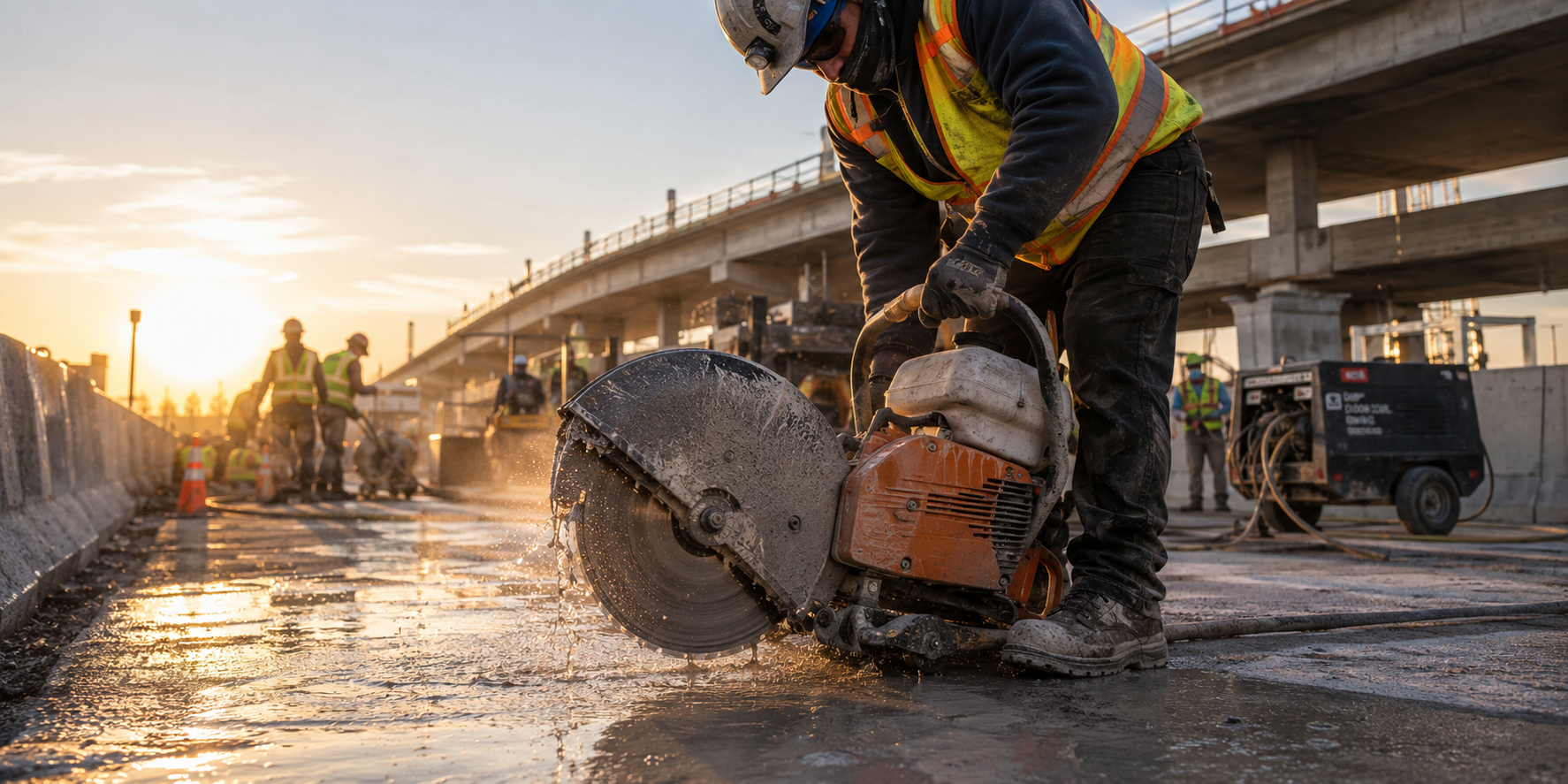
Diamond Tools for Commercial Construction
One saw crossing four materials in an afternoon, penetrations through everything, and a building full of other trades who will notice your dust long before they notice your work.
The job rarely stays on one material
Commercial fit-out and shell-and-core work moves between materials constantly. You open a block wall, meet a concrete lintel, then trim brick on the same afternoon. Changing blades three times costs more in downtime than the blades cost, which is the entire argument for a combination rim.
The All-Purpose Combo Blade is a deliberate compromise: slotted enough to clear debris in concrete, with a medium bond that survives soft abrasive block. It will not out-cut a dedicated blade in either material, and on sustained production cutting you should buy the matched blade instead. On mixed work it is the more valuable tool.
Every service needs a hole
Mechanical, electrical and plumbing first fix turns into hundreds of penetrations. The decision each time is whether you can use water. In an occupied floor, above a finished ceiling, or on a slab with tenants below, the slurry costs more to clean up than the hole costs to drill.
That is what dry core bits are for — a turbo crown in block, brick and masonry up to 6″, run with a vacuum attachment. For structural slabs and anything reinforced you need wet barrels and a proper water catch. Thread and adapter compatibility is set out in the core bit size and thread guide.
Fumes, noise and dust are the real constraints
A petrol cutter cannot be used in an occupied corridor, a plant room or an underground car park, and no amount of extraction makes a two-stroke acceptable in an enclosed space. That single fact drives most equipment choices on commercial sites.
Battery machines remove the emissions question entirely and start instantly, which suits work made up of twenty short cuts across a day. For masonry cutting where dust is the issue rather than fumes, the iQ dust control masonry saw builds the extraction into the machine so there is nothing to rig. Machines are in cut-off saws.
The cut that ends up on show
Late in a commercial job the cutting becomes visible: porcelain in washrooms and lobbies, stone sills and reception cladding, polished concrete in retail space. Edge quality now matters more than speed, and the rim type decides it.
Porcelain chips on the exit face, so a continuous rim run wet is the only sensible choice for finished tile. Softer stone and marble take the same approach. Where a slab has to be brought back to a finish, work through the grits in sequence with a wet polishing pad set rather than trying to jump steps.
Know what is in the slab before the bit goes in
The most expensive hole on a commercial job is the one drilled through a post-tension tendon. Unlike ordinary reinforcement, a tendon is under load. Cutting one does not just weaken the slab locally, it releases stored energy and can require an engineered repair across the whole bay. On a post-tensioned deck, scanning is not optional diligence, it is the job.
Scanning also changes what you buy. If the survey shows you can shift a penetration six inches and miss the reinforcement entirely, you drill a clean hole with a standard bit. If the hole has to stay where the mechanical drawing puts it and that means going through two mats of steel, you need a bit specified for reinforced concrete, and you need to expect a slower rate and a shorter life.
Get the approval in writing before the core rig is set up. Structural sign-off on penetration locations, sizes and edge distances is what stands between a routine hole and a remediation. Coring is destructive and instantaneous; approvals are neither.
Two habits that save arguments. Record the actual as-drilled positions rather than the drawing positions, because the next trade will drill to whatever they find on site. And agree who is responsible for the water: a rig on an occupied floor over a finished space below needs containment and a vacuum, and that is a conversation to have with the general contractor rather than the tenant.
Check the barrel length against the slab, not the drawing. A core bit is specified by diameter and by usable depth, and a 12 inch barrel does not drill a 14 inch slab. Where the penetration is deeper than the bit, you need an extension and a rig set up to take the extra length without wandering — decided before the crew is on the floor, not after the first hole stops short.
Related: diamond core bits, core bit sizes and thread guide, core drills.
Frequently Asked Questions
What is the best blade for mixed-material cutting on a commercial site?
A combination rim with a medium bond, such as the DOT All-Purpose Combo Blade. It handles concrete, block, brick and general masonry without a blade change. For production cutting in a single material, a matched blade cuts faster and costs less per foot.
Can I core drill inside an occupied building?
Yes, but usually dry. Dry core bits with a vacuum attachment suit block, brick and masonry up to about 6 inches. Structural slabs and reinforced concrete need wet barrels, which means planning water capture before you start.
What saw can I use indoors without ventilation problems?
A battery-powered cutter, or a saw with integrated dust extraction. Petrol cutters produce exhaust that cannot be made acceptable in an enclosed occupied space regardless of extraction.
How do I stop porcelain tile chipping when cutting?
Use a continuous rim blade and run it wet. Every gullet in a segmented or turbo rim is an interruption in the cutting edge, and each interruption is a chance to spall the glaze on the underside of the cut. Feed slowly and score the last quarter inch.
Do I need different blades for block and for concrete?
Ideally yes. Block is soft and abrasive and takes a hard bond; cured concrete is hard and dense and takes a soft bond. A combo blade bridges both acceptably where the work is genuinely mixed.
Kit that works inside an occupied building
Tell us the building, the trades on site and the materials, and we will put a list together.
Talk to a Specialist