
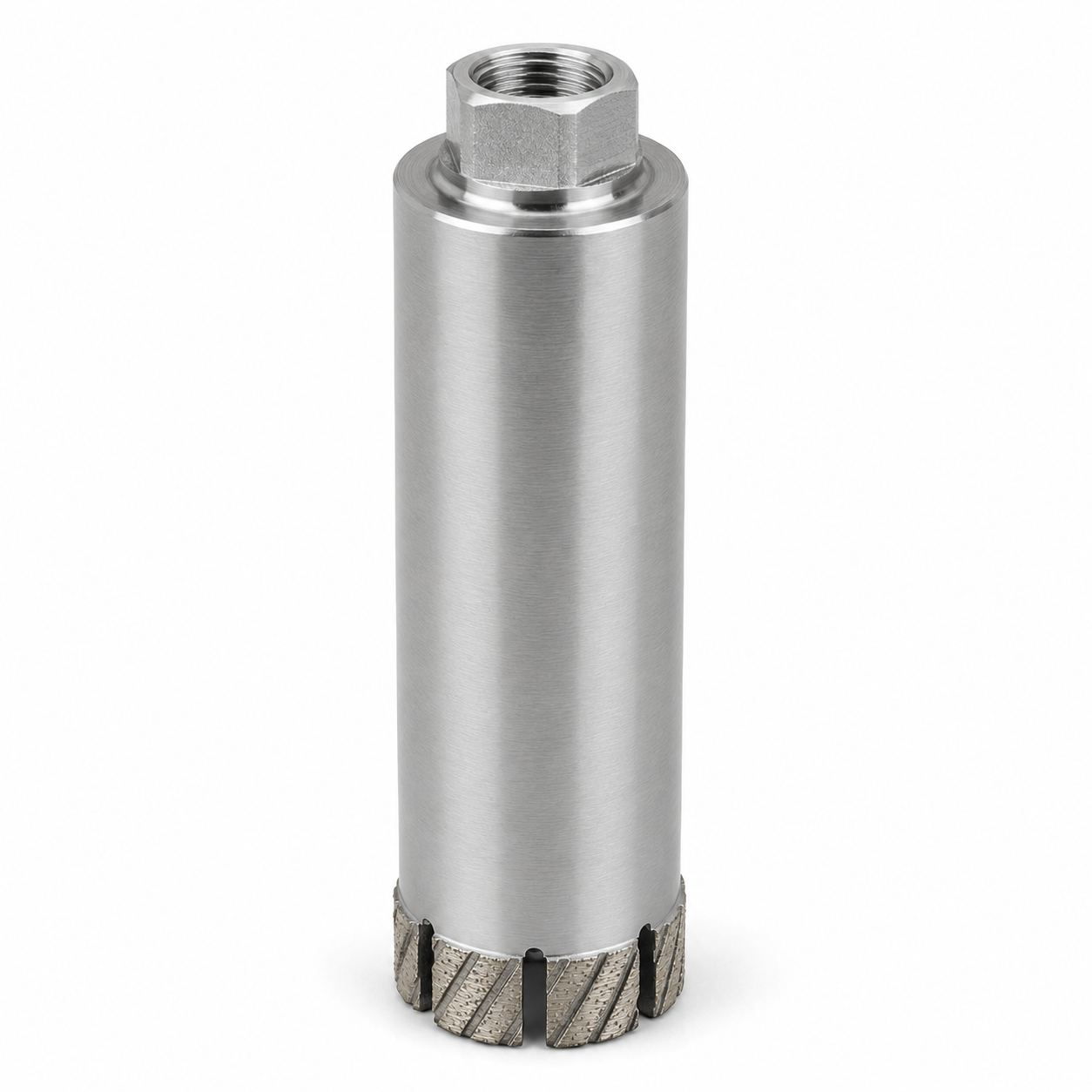
Description
There are places you simply cannot use water. An occupied office, a finished floor, a second-story block wall with a tenant beneath it — anywhere the slurry costs more to clean up than the hole costs to drill. That is the whole case for a dry bit.
What dry drilling gives up, and what it does not
Dry bits run a turbo crown, whose continuous serrated profile lets air do the job water normally does: carrying heat away and clearing dust. The trade is depth and material. This bit is for block, brick and masonry — not for hard cured concrete and not for reinforcement. Take it into a rebar-laden structural slab and you will lose the crown. Withdraw the bit every few inches to clear the dust and let it cool, and it will last; bury it and lean on it, and it will not.
Nine sizes, 1″ to 6″
Available 1″, 1.5″, 2″, 2.5″, 3″, 3.5″, 4″, 5″ and 6″ — the normal spread for electrical boxes, dryer and bathroom vents, small pipe penetrations and cavity ties through masonry.
Use a vacuum attachment. Dry drilling masonry is a high silica-exposure task. For cured concrete or anything reinforced, drill wet with the Wet Core Bit; adapter and thread detail is covered in our guide to core bit sizes and threads, and the full range is under dry core bits.