
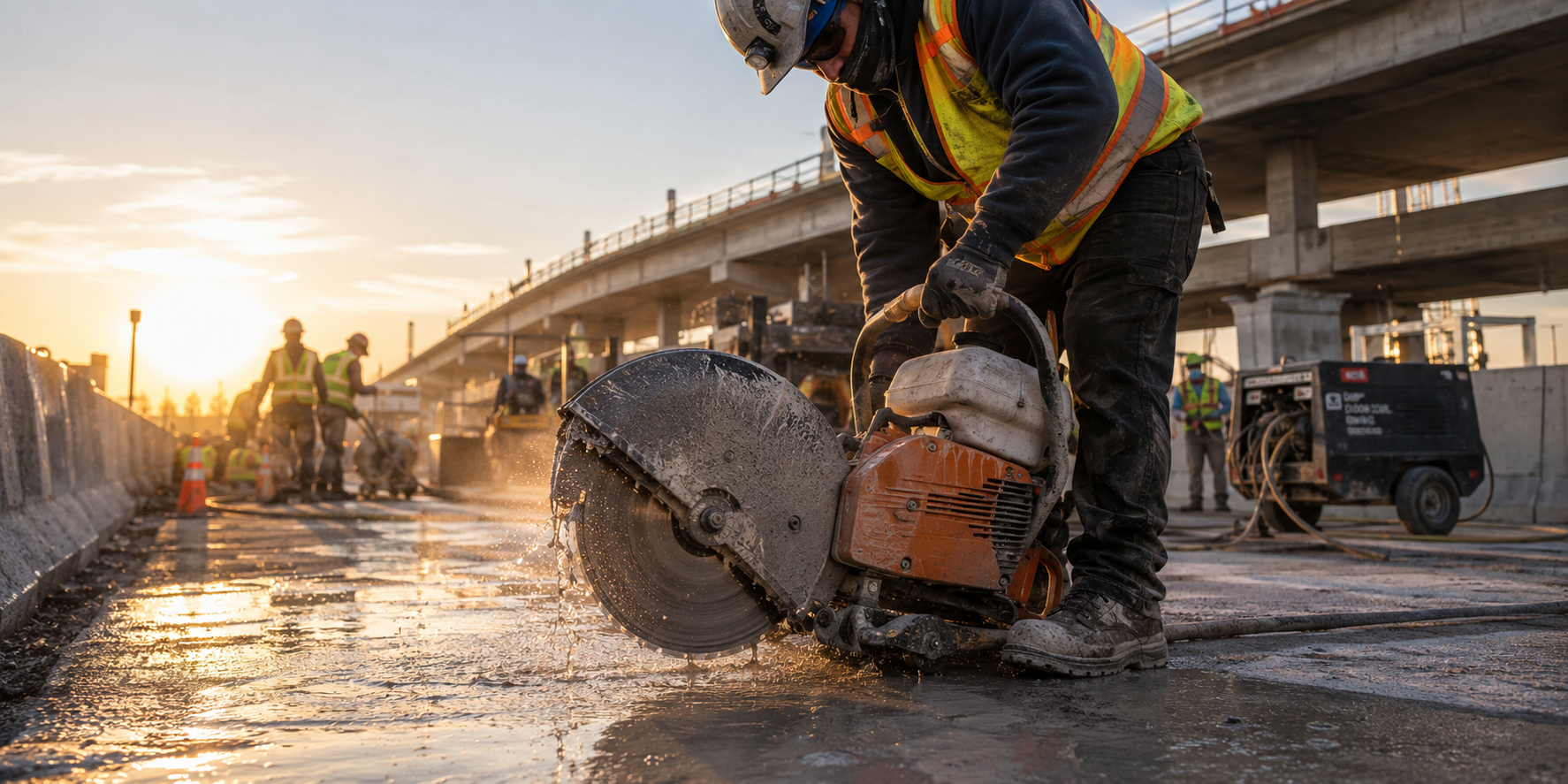
How to Cut and Core-Drill Rebar-Reinforced Concrete
To cut or drill rebar-reinforced concrete, use a diamond blade or core bit rated for reinforced concrete, work wet, scan the slab first, and use slow, steady feed when you hit steel. The water cools the rebar instantly and keeps the diamonds from glazing.
Can a diamond blade cut through rebar?
Yes. A quality diamond blade rated for reinforced concrete cuts straight through embedded rebar. The key is heat management: steel generates heat fast, so cut wet and don’t force the blade.
Core-drilling through rebar
Diamond core bits drill through rebar routinely. Mount the bit on a rig, keep water flowing, and slow your feed rate when you reach steel. Use a wet core bit rated for reinforced concrete for the best life.
Feed and pressure — the glazing trap
Use even, steady pressure. Too little and the diamonds glaze over (polish smooth and stop cutting); too much and you overload the motor or deflect the bit. If the bit stops cutting, it’s glazed — dress it on an abrasive block and ease your pressure.
Scan and plan first
Use a rebar scanner or metal detector before you cut or drill so you can plan the path. Cutting structural rebar can compromise a slab or beam — when in doubt, consult a structural engineer before cutting reinforcement.
Questions on a reinforced job? Call our team at (701) 922-1526.
What actually happens when the blade meets steel?
Concrete and steel wear a diamond blade by completely different mechanisms, and a blade cutting reinforced concrete is doing both jobs at once.
Concrete is abrasive and erodes the metal matrix, exposing fresh diamond as it goes. Steel does not. It is ductile, it smears rather than abrades, and it work-hardens the diamond face instead of opening it. That is why a blade can be cutting beautifully in slab and then feel like it has hit a wall at the first bar: the rim has effectively been polished by the steel and stopped presenting sharp diamond.
The recovery is counterintuitive but reliable. Keep cutting into the concrete beyond the bar rather than backing off, and the abrasive material will re-open the matrix within a few inches. Blades specified for reinforced work carry a bond formulated to survive that cycle repeatedly, which is what separates them from a plain concrete blade.
Partial-depth or full-depth on a reinforced slab?
The decision changes the tooling as well as the method, and getting it wrong is expensive on a structure.
Partial depth
Saw the perimeter of the unsound area to a controlled depth, then break out to the top mat without damaging the steel you intend to keep. Depth control matters more than speed. The one-third-of-diameter rule still governs, so a 14 inch blade takes roughly 4-1/2 inches per pass, and on a repair perimeter you often want considerably less than that.
Full depth
Usually a walk-behind saw following a marked boundary, cutting right through the slab. Here the sawn face becomes a construction joint that the new pour has to bond to, so a clean square cut is structural rather than cosmetic. Size the blade so it clears the slab in one pass, because a stepped or overlapping cut leaves a ragged face.
Either way, ease the feed the moment the blade meets steel, and never force the saw to make up time. Forcing is what loads a segment shoulder until it fails.
Frequently Asked Questions
Can a diamond blade cut through rebar?
Yes. A diamond blade rated for reinforced concrete will cut the steel reinforcement, though hitting rebar increases wear, so choose a blade built for the job.
Which diamond blade is best for reinforced concrete?
A segmented blade with a hard bond and a reinforced, undercut-protected core. The hard bond holds up to the steel while the tough core resists cracking.
Does cutting rebar wear out the blade faster?
It does. Steel is abrasive on diamond segments, so expect shorter blade life than cutting plain concrete. A blade matched to rebar-laden concrete minimizes the loss.
Should I cut reinforced concrete wet or dry?
Wet cutting keeps the blade cooler and extends its life when cutting through steel, and it also controls silica dust. Use a blade rated for the method you choose.
Why does my blade slow down at the rebar and not recover?
Steel smears rather than abrades, so it polishes the diamond face instead of opening the matrix. Keep cutting into the concrete past the bar rather than backing off. The abrasive concrete will re-expose fresh diamond within a few inches.
Should I use a different blade for reinforced concrete?
Yes, where you cut it regularly. Blades specified for rebar-reinforced work use a bond formulated to survive repeated cycles of steel polishing the rim and concrete re-opening it. A plain concrete blade will cut steel but degrades faster doing it.
How deep should I cut around a partial-depth repair?
Deep enough to reach sound concrete and define a clean perimeter, without cutting the reinforcement you intend to keep. Depth control matters more than speed here, and it is usually well under the one-third-of-diameter maximum the blade allows.
Sources and further reading
The regulatory and specification points above are taken from the sources below. Each link goes to the issuing body, not to a summary of it, so you can verify the requirement against the original.
- 29 CFR 1926.1153 — Respirable Crystalline Silica — Occupational Safety and Health Administration. The construction standard itself, including Table 1.
- Table 1: Handheld Power Saws (PDF) — OSHA fact sheet. Specifies a continuous water feed as the engineering control.
- Table 1: Rig-Mounted Core Saws or Drills (PDF) — OSHA fact sheet. Water supply requirements for core drilling.
Have Questions or Need a Recommendation?
Call our team for expert advice and the right tools for your job.
Call our team at (701) 922-1526