
Controlling Silica Dust When Cutting Concrete (OSHA Table 1)
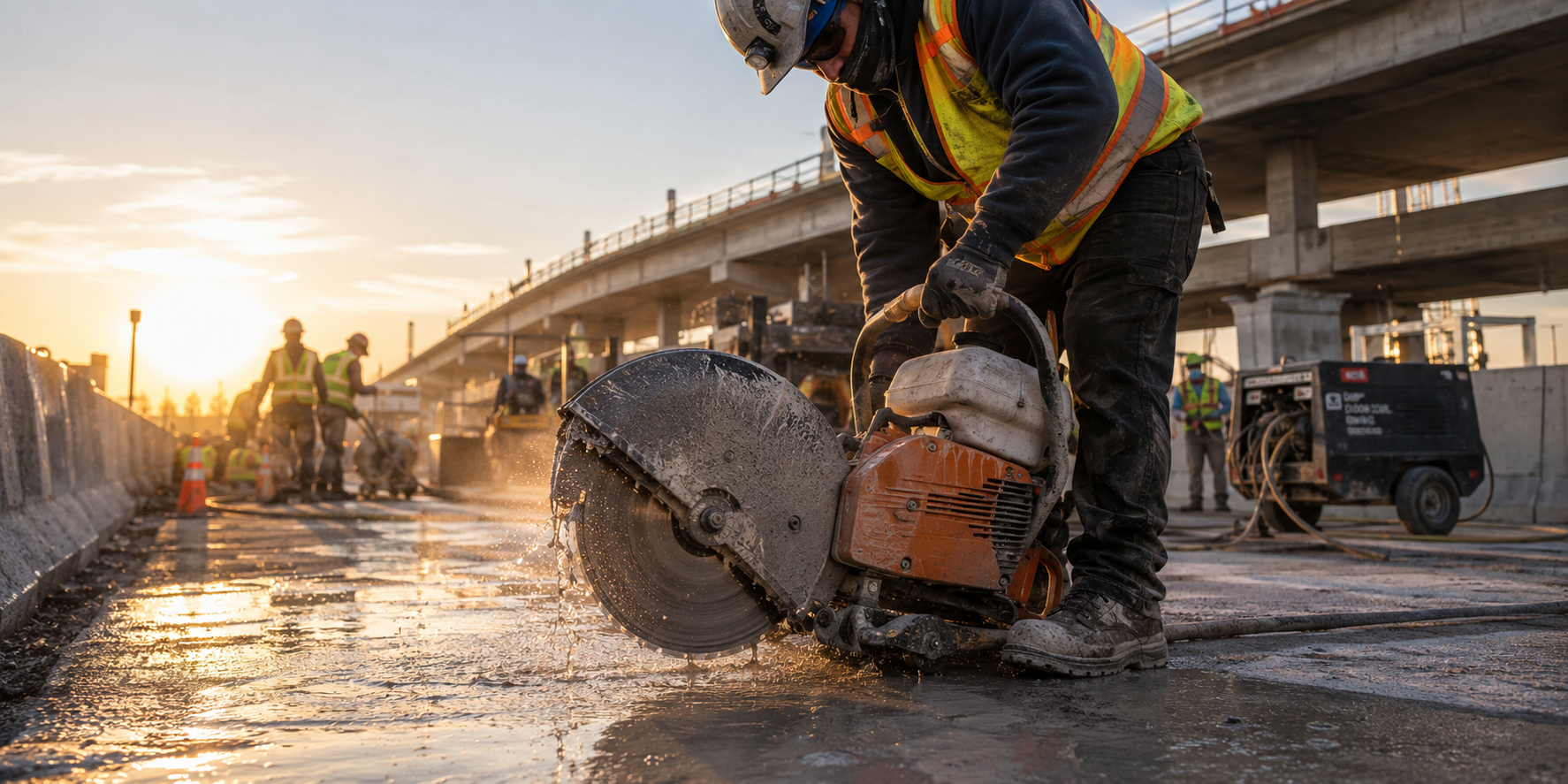
To control silica dust when cutting concrete, cut wet or use a saw with vacuum dust collection — both are recognized OSHA Table 1 controls. Cutting concrete dry without controls releases respirable crystalline silica that can exceed OSHA limits within minutes.
Why silica dust is a serious hazard
Cutting, grinding, or drilling concrete, masonry, and stone releases respirable crystalline silica — particles small enough to lodge deep in the lungs. Long-term exposure causes silicosis, lung cancer, and COPD. It’s one of the most regulated jobsite hazards.
What is OSHA Table 1?
OSHA’s Respirable Crystalline Silica standard (29 CFR 1926.1153) includes “Table 1” — a list of common tasks with specified dust controls. Follow the control for your task (e.g., wet cutting or integrated dust collection) and you’re deemed compliant without separate air monitoring.
The two compliant approaches
Wet cutting: a continuous water feed at the blade suppresses dust at the source — simple and effective. Vacuum dust collection: a saw or grinder with a shroud connected to a HEPA dust extractor captures dust for dry cutting where water isn’t practical.
Compliant equipment
Power cutters with integrated water (e.g., Husqvarna K770/K1 PACE, Makita XEC01) and dust-control saws (iQ Power Tools) are built for Table 1 compliance. See our saws & equipment or call our team at (701) 922-1526.
What does Table 1 require for each task?
Table 1 is organized by task rather than by tool, and the control it demands changes sharply between them. These are the entries that matter to concrete cutting and drilling.
Stationary masonry saws require an integrated water delivery system that continuously feeds the blade, with no respirator needed at any duration. Handheld power saws of any blade diameter also require integrated water; outdoors no respirator is needed for four hours or less, indoors one is required regardless.
Walk-behind saws require integrated water and no respirator outdoors. Rig-mounted core saws and drills require a water delivery system supplying the cutting surface, and again no respirator. Wet cutting is doing double duty on all four: it is the compliance control, and it is what buys you blade life.
Handheld and stand-mounted drills take a different route entirely. There is no water option; they require a shroud or cowling with dust collection at 99% or better filtration and a filter-cleaning mechanism, plus a HEPA vacuum for clearing the hole.
Dowel drilling rigs are the outlier worth memorising: outdoors only, shroud and collection at 99% with filter cleaning, HEPA vacuum for the holes, and a respirator at any duration. It is the only entry in the whole table demanding respiratory protection no matter how briefly the task runs.
What specification does the dust collector have to meet?
The filtration percentage is not the hard part. Most shop vacuums claim 99%. The requirement that catches people out is the filter-cleaning mechanism, which Table 1 demands on every drilling and grinding entry relying on dust collection rather than water.
The reason is straightforward. Concrete dust blinds a filter within minutes, airflow collapses, and a collector that met specification at the start of the shift is moving almost nothing by mid-morning. A filter-cleaning mechanism, whether automatic pulse or manual, restores that airflow. A vacuum without one is compliant on paper for about ten minutes of real work.
Two figures worth getting right
For handheld grinders, Table 1 specifies a collector rated at 25 cfm or greater per inch of wheel diameter, 99% filtration, and either a cyclonic pre-separator or a filter-cleaning mechanism. Mortar removal with a grinder also carries the only APF 25 respirator requirement in the table beyond four hours.
There is a widely repeated claim in this trade that Table 1 sets a cfm figure per inch of blade diameter for saws. It does not. The only airflow number in the table applies to grinder wheels. Saw and drill entries say only that airflow should meet the tool manufacturer’s recommendation or better. Quoting the wrong figure to a safety officer costs credibility you will not easily recover.
Housekeeping is part of the rule
The standard also restricts how you clean up. Dry sweeping and dry brushing are not permitted where wet sweeping or HEPA vacuuming is feasible, and compressed air may not be used to clear dust unless paired with capture ventilation or where no alternative exists. That cuts directly against the traditional compressed-air blowout step in joint and crack sealing work.
Frequently Asked Questions
How do I control silica dust when cutting concrete?
Use wet cutting to suppress dust at the blade, or a saw fitted with a dust-collection shroud and a HEPA-filtered vacuum. Both are recognized control methods under OSHA’s silica standard.
What is OSHA Table 1?
Table 1 in OSHA standard 1926.1153 lists specific equipment-and-control combinations for common silica-generating tasks. Follow the matching entry and you don’t need to perform separate air monitoring.
Is dry cutting concrete legal?
Yes, as long as you use a dust-collection system with a HEPA-filtered vacuum that meets Table 1 requirements. Uncontrolled dry cutting that lets visible dust escape is not compliant.
What equipment meets OSHA Table 1 for concrete cutting?
A saw with integrated water delivery for wet cutting, or a dust-collection shroud paired with a HEPA vacuum sized to the blade. Operators should also wear appropriate respiratory protection.
Does Table 1 require a specific airflow for saw dust collection?
No. The only airflow figure in Table 1 is 25 cfm per inch of wheel diameter, and it applies to handheld grinders. Entries for saws and drills require only the airflow recommended by the tool manufacturer or greater. The claim that a cfm-per-inch-of-blade-diameter rule exists for saws is incorrect.
Why does a dust vacuum need a filter-cleaning mechanism?
Because concrete dust blinds a filter within minutes and airflow collapses. Table 1 requires a filter-cleaning mechanism on drilling and grinding tasks that rely on dust collection. A vacuum meeting 99% filtration with no way to clear its filter stops performing early in the shift and does not satisfy the standard.
Which task requires a respirator no matter how briefly it runs?
Dowel drilling rigs for concrete. It is the only Table 1 entry requiring respiratory protection at any duration, alongside outdoor-only use, a shroud with 99% collection and filter cleaning, and a HEPA vacuum for clearing holes.
Can I use compressed air to blow dust out of a joint?
Only where it is used together with capture ventilation, or where no feasible alternative exists. The housekeeping provisions restrict compressed air and prohibit dry sweeping where wet sweeping or HEPA vacuuming would work. This affects the traditional blowout step in joint and crack sealing.
Sources and further reading
The regulatory and specification points above are taken from the sources below. Each link goes to the issuing body, not to a summary of it, so you can verify the requirement against the original.
- 29 CFR 1926.1153 — Respirable Crystalline Silica — Occupational Safety and Health Administration. The construction standard itself, including Table 1.
- Silica, Crystalline — Construction — OSHA. Employer duties, Table 1 alternatives and the full set of task fact sheets.
- OSHA’s Crystalline Silica Rule: Construction (PDF) — OSHA. Plain-language summary of what the standard requires.
- Small Entity Compliance Guide for Construction (PDF) — OSHA. Engineering controls, exposure assessment and written control plans.
- Table 1: Handheld Power Saws (PDF) — OSHA fact sheet. Specifies a continuous water feed as the engineering control.
- Table 1: Walk-Behind Saws (PDF) — OSHA fact sheet. Water delivery requirements for walk-behind concrete saws.
- Table 1: Stationary Masonry Saws (PDF) — OSHA fact sheet. Integrated water delivery for tile and masonry saws.
- Table 1: Handheld Grinders for Mortar Removal (PDF) — OSHA fact sheet. Dust controls for tuck pointing.
- Table 1: Handheld Grinders, Other Than Mortar Removal (PDF) — OSHA fact sheet. Controls for surface grinding and coating removal.
- Table 1: Rig-Mounted Core Saws or Drills (PDF) — OSHA fact sheet. Water supply requirements for core drilling.
- Table 1: Handheld and Stand-Mounted Drills (PDF) — OSHA fact sheet. Dust collection for drilling into concrete and masonry.
- Table 1: Walk-Behind Milling Machines and Floor Grinders (PDF) — OSHA fact sheet. Controls for floor grinding and scarifying.
- National Emphasis Program — Respirable Crystalline Silica — OSHA directive CPL 03-00-023. How the standard is enforced on site.
- Working Safely with Silica — The Center for Construction Research and Training (CPWR). Planning tools and task-level guidance.
Have Questions or Need a Recommendation?
Call our team for expert advice and the right tools for your job.
Call our team at (701) 922-1526