
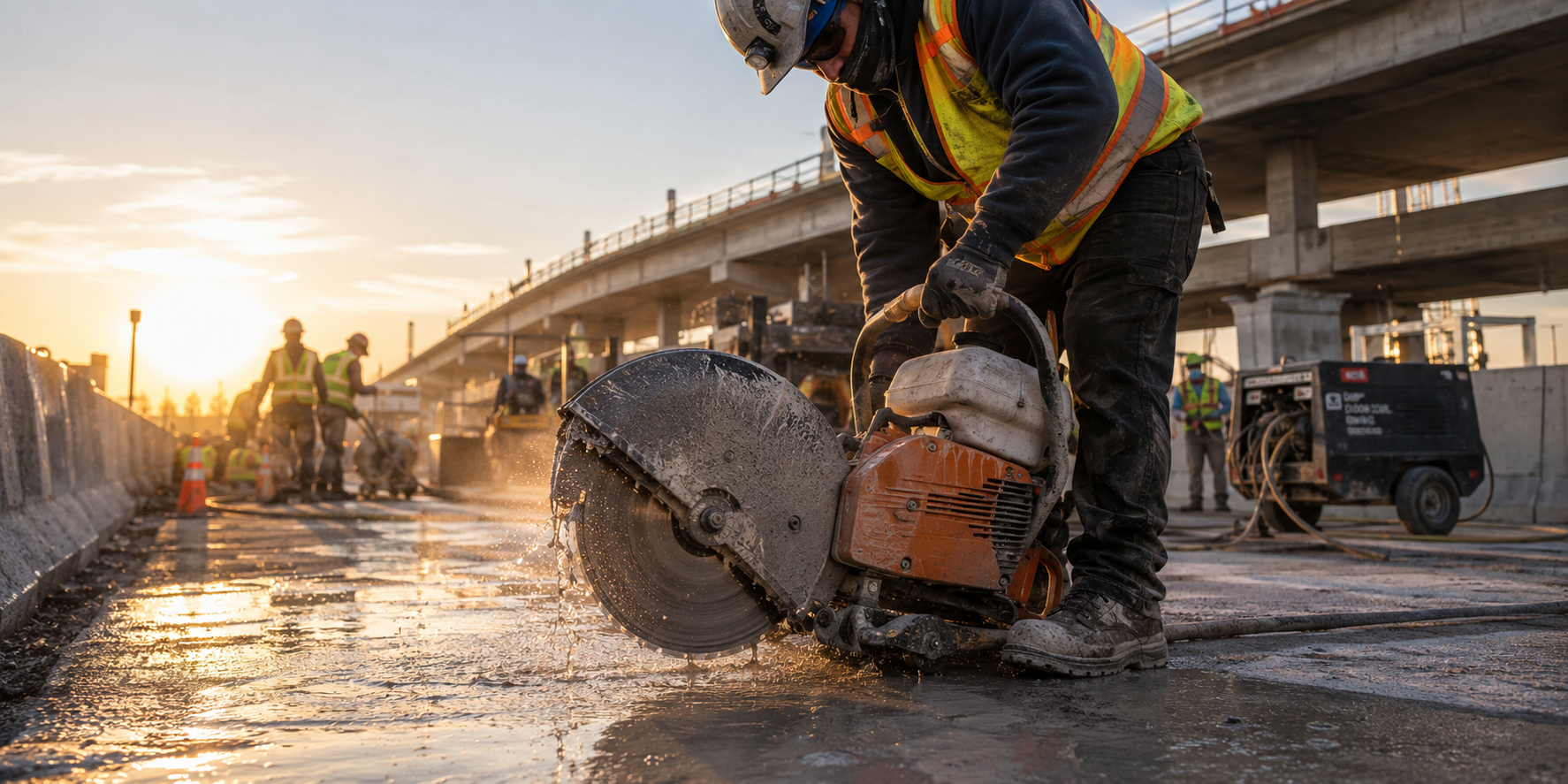
Wet vs Dry Concrete Cutting: Which Is Better?
Cut wet whenever possible. Wet cutting gives 2–3× longer blade life, a cleaner cut, and controls respirable silica dust for OSHA Table 1 compliance. Dry cutting is for short cuts or where water isn’t practical — and should be paired with dust collection.
Why cut wet?
Water cools the blade, so the diamonds and bond last far longer — typically 2–3× the life of a dry cut. It also flushes slurry from the cut for a cleaner result and, critically, suppresses the fine crystalline-silica dust that concrete cutting throws off.
When is dry cutting OK?
Dry cutting is fine for short, intermittent cuts, indoor work where water creates a mess, or quick field cuts with a handheld saw. Use a blade rated for dry cutting, let it cool between cuts, and add a dust-collection shroud. Never dry-cut tile or stone — they chip and overheat.
What about silica dust and OSHA?
Cutting concrete dry without controls can exceed OSHA’s respirable-silica limit within minutes. Wet cutting (or a vacuum dust-collection saw) is the simplest path to OSHA Table 1 compliance and protects your crew’s lungs.
Does wet always win?
For blade life, cut quality, and dust control, yes. The trade-offs are slurry cleanup and the need for a water source. For most production cutting, those are worth it. Shop diamond blades rated for wet or dry, or call our team at (701) 922-1526.
What does wet cutting actually cost you?
Wet cutting is presented as the obvious choice, and on blade life and dust it is. But it is not free, and pretending otherwise leads crews to arrive unprepared.
Water that has passed through a saw kerf is not water any more. It is alkaline slurry carrying fine cement particles, and on most sites it cannot simply run to a drain. On a bridge deck there is usually a watercourse below. Indoors it will find its way into finishes and lift sections. On a highway job it becomes a traffic hazard as it spreads.
So the real cost of wet cutting is containment and disposal: bunding, vacuum recovery, and an agreed route for the slurry. On a regulated project that plan may be a permit condition. It is still usually the right choice, but budget the containment alongside the water, not as an afterthought.
What do you do when neither wet nor dry is straightforward?
Plenty of real jobs sit in the gap: indoors where slurry is unacceptable, but cutting concrete where dust is equally unacceptable.
Occupied and finished interiors
On-tool dust extraction rather than water. A shroud with a compliant collector, and a HEPA vacuum for clearing debris. Slower than wet cutting, but nothing to clean up and nothing to damage.
No water supply on site
A pressurised water bottle gives a handheld saw the continuous integrated feed the regulations expect, without a standpipe. It is a small piece of kit that converts a non-compliant dry cut into a compliant wet one.
Cold weather
Below freezing, water in the tank, the feed lines and the kerf becomes a genuine problem, and slurry on a trafficked surface becomes a hazard. This is the one case where dry cutting with extraction is often the more sensible answer outright.
The decision is rarely about which method is better in principle. It is about which constraint on this particular job is hardest to work around.
Frequently Asked Questions
Is wet or dry cutting better?
Wet cutting reduces dust and heat and extends blade life, making it ideal for long or deep cuts. Dry cutting is faster to set up and better suited to short cuts or where water isn’t practical.
Can I dry cut with any diamond blade?
No. Only use blades rated for dry cutting. Wet-only blades depend on water for cooling and can overheat, warp or lose segments if run dry.
Does wet cutting need special equipment?
You need a water supply or feed to the blade and a way to manage the resulting slurry. Many walk-behind and handheld saws have integrated water delivery.
Is dry cutting more hazardous?
Dry cutting generates more airborne silica dust, so it requires a dust-collection system or HEPA vacuum to stay compliant and protect the operator.
What are the hidden costs of wet cutting?
Slurry containment and disposal. Water that has passed through the kerf is alkaline and carries cement fines, so on most sites it cannot go to a drain. Budget for bunding, vacuum recovery and an agreed disposal route, which on regulated work may be a permit condition.
How do I cut concrete indoors without slurry?
Use on-tool dust extraction rather than water: a shroud with a compliant dust collector, plus a HEPA vacuum for clearing debris. It cuts more slowly than wet, but leaves nothing to clean up and cannot damage finishes.
Is dry cutting ever the better choice?
Yes. In freezing conditions water in the tank, lines and kerf becomes unworkable and slurry on a trafficked surface is a hazard. Indoors on finished floors, dust extraction is often preferable to slurry. The decision is about which constraint is hardest to work around on that job.
Sources and further reading
The regulatory and specification points above are taken from the sources below. Each link goes to the issuing body, not to a summary of it, so you can verify the requirement against the original.
- 29 CFR 1926.1153 — Respirable Crystalline Silica — Occupational Safety and Health Administration. The construction standard itself, including Table 1.
- Silica, Crystalline — Construction — OSHA. Employer duties, Table 1 alternatives and the full set of task fact sheets.
- Table 1: Handheld Power Saws (PDF) — OSHA fact sheet. Specifies a continuous water feed as the engineering control.
- Table 1: Walk-Behind Saws (PDF) — OSHA fact sheet. Water delivery requirements for walk-behind concrete saws.
- OSHA’s Crystalline Silica Rule: Construction (PDF) — OSHA. Plain-language summary of what the standard requires.
Have Questions or Need a Recommendation?
Call our team for expert advice and the right tools for your job.
Call our team at (701) 922-1526