
Best Diamond Blade for Cutting Concrete: A Contractor’s Guide
The best diamond blade for cutting concrete is a soft-bond segmented blade for hard or cured concrete, and a hard-bond blade for green concrete, sized and arbored to your saw and run wet whenever possible. Below is how to pick the right one in under two minutes — from a team led by a founder with 35+ years in diamond tooling.
What bond do I need for concrete?
Match the bond to concrete hardness, and remember the rule runs backwards from what most people expect. Hard, cured concrete needs a soft bond so it keeps exposing fresh diamonds; green or abrasive concrete needs a hard bond so it does not wear out before the diamonds do their job. If a blade stops cutting on hard concrete, it is glazed — go softer.
Segmented, turbo, or continuous rim for concrete?
Use a segmented blade for almost all concrete cutting. Segmented rims clear debris and cut fast; turbo rims cut nearly as fast with a smoother edge; continuous rim blades are for chip-free finish work and run wet.
Should I cut concrete wet or dry?
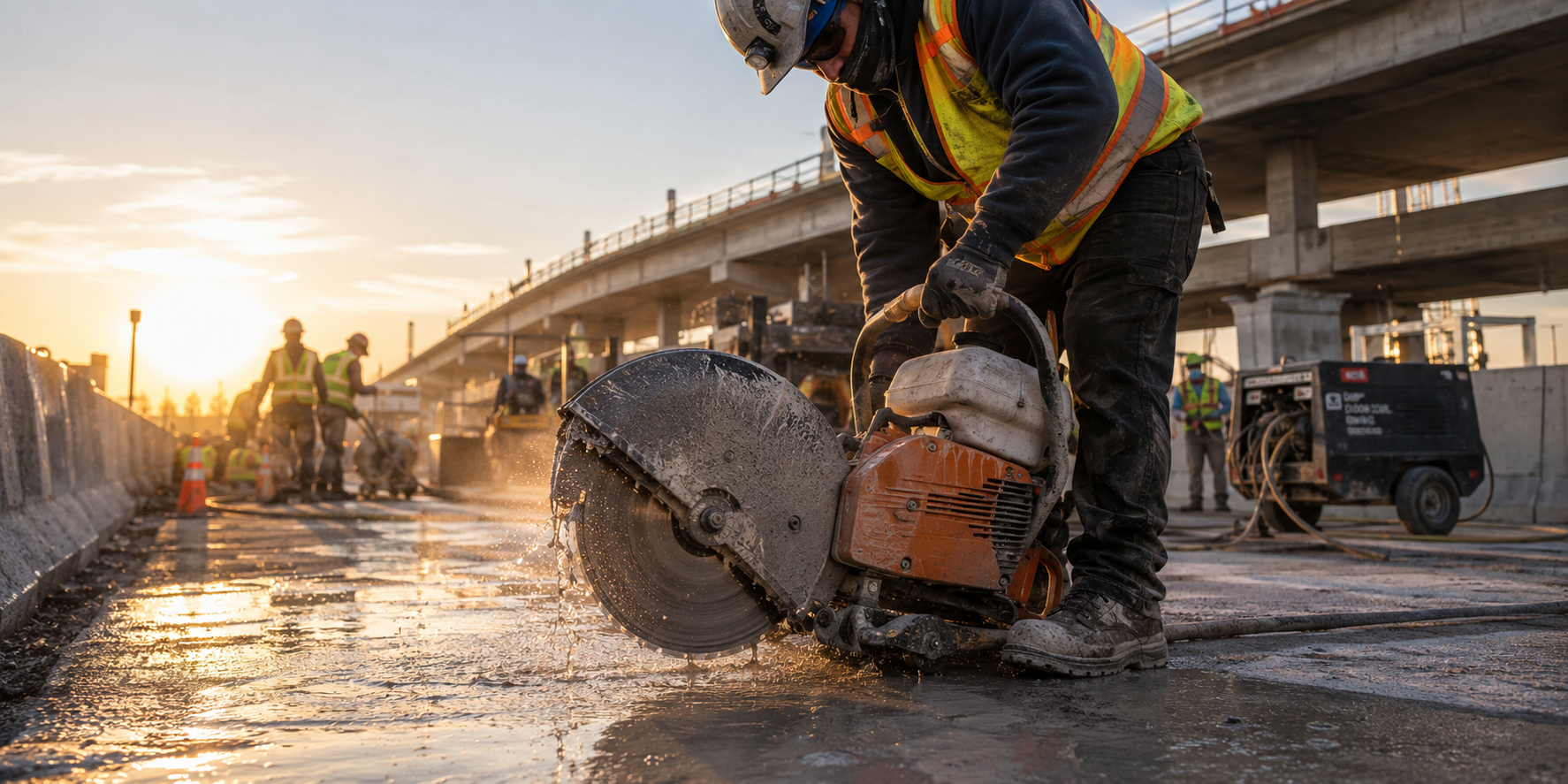
Cut wet whenever you can. Wet cutting delivers 2–3× longer blade life, a cleaner cut, and controls respirable silica dust for OSHA Table 1 compliance. Reserve dry blades for short cuts, paired with vacuum dust collection.
What size and arbor should I choose?
Pick the diameter for your cut depth (max depth is roughly one-third of blade diameter) and match the arbor to your saw — typically 7/8″–5/8″ on handheld saws and 1″/20mm on high-speed and walk-behind saws.
Can the same blade cut rebar-reinforced concrete?
Yes, with the right setup. Cut wet and use a blade rated for reinforced concrete. For drilling reinforced slabs, use a diamond core bit rated for rebar — see our core bits.
The short answer
For most contractors cutting cured concrete: a soft-bond segmented blade, sized to your saw, cut wet. Shop matched options on our concrete diamond blades page, or call our team at (701) 922-1526.
How long should a concrete blade last?
There is no honest figure in linear feet, because the same blade in the same saw will give wildly different life depending on the aggregate. Hard river gravel wears a blade several times faster than soft limestone, and heavily reinforced slab faster again. What you can control is whether the blade reaches its potential or fails early.
Four things shorten blade life more than anything else: the wrong bond for the material, cutting dry when water was available, forcing the feed rate, and burying the blade past a third of its diameter. Each is an operator or specification decision rather than a property of the blade, which is why two crews running identical blades often report very different results.
Wet cutting alone typically returns two to three times the life of the same blade run dry, so if you are comparing cost per foot between suppliers, make sure you are comparing the same cutting method.
What does a worn or damaged blade tell you?
A retired blade is a diagnostic record. Learning to read one stops you repeating the mistake on the next.
Glazing
The rim looks polished and cutting has slowed to a crawl. The diamonds have worn flat instead of fracturing, which means the bond is too hard for the material. Leaning on the saw makes it worse. Move to a softer bond.
Fast wear with segments still sharp
The opposite problem. The matrix is eroding faster than the diamond is wearing, so you are throwing away good diamond. The bond is too soft for the material, which usually means the material is more abrasive than you assumed.
Undercutting
Damage on the steel core beneath the segments rather than on the segments themselves. Abrasive slurry has scoured the shoulder until it thinned. Common in asphalt and green concrete, and the reason blades for those materials carry sacrificial wear protection.
A cupped or wandering blade
The core has warped from heat, usually an interrupted water feed or a dry pass on a wet-only blade. It cuts wide, wanders off the line and cannot be trued. Prevention is the only remedy.
Frequently Asked Questions
What diamond blade is best for cutting concrete?
For cured concrete, a soft-bond segmented blade is the right choice — a soft matrix keeps eroding so fresh diamond stays exposed against hard, dense material. For fresh or green concrete, choose a harder bond with undercut protection to resist premature wear.
What’s the difference between cured and green concrete blades?
Green-concrete blades use a harder bond and undercut protection because fresh concrete is abrasive. Cured-concrete blades use a softer bond so they keep cutting hard, set material.
What size diamond blade do I need for concrete?
Match the blade to your saw. 12″ to 14″ blades are common on walk-behind and cut-off saws, while smaller blades suit angle grinders.
Should I cut concrete wet or dry?
Both work. Wet cutting reduces dust and extends blade life; dry cutting is more convenient for short cuts. Always use a blade rated for the method.
How many feet should I get from a concrete blade?
There is no reliable universal figure, because aggregate hardness changes blade life by a factor of several. Hard river gravel wears a blade far faster than soft limestone. Compare cost per foot only between crews cutting similar material by the same method.
Why has my new blade stopped cutting already?
Almost always glazing. The rim looks polished and the diamonds have worn flat rather than fracturing, because the bond is too hard for the material you are cutting. Pressing harder accelerates the problem. Switch to a softer bond.
Does wet cutting really extend blade life?
Yes, typically by two to three times against the same blade run dry. It also controls silica dust and produces a cleaner cut. Where a saw has a water feed, there is rarely a good reason not to use it.
Sources and further reading
The regulatory and specification points above are taken from the sources below. Each link goes to the issuing body, not to a summary of it, so you can verify the requirement against the original.
- 29 CFR 1926.1153 — Respirable Crystalline Silica — Occupational Safety and Health Administration. The construction standard itself, including Table 1.
- Table 1: Handheld Power Saws (PDF) — OSHA fact sheet. Specifies a continuous water feed as the engineering control.
- Concrete Pavement Rehabilitation — Guide for Diamond Grinding — Federal Highway Administration, FHWA-SRC-1/10-01(SM). Diamond head specification, construction practice and performance.
Have Questions or Need a Recommendation?
Call our team for expert advice and the right tools for your job.
Call our team at (701) 922-1526