
Diamond Tools for Utility Contractors
Trench cuts across live carriageway, penetrations through vault walls and basements, and a reinstatement that still looks square when the inspector arrives.
Cutting the trench line cleanly
A utility trench starts and ends with a saw cut, and the quality of that cut determines how good the reinstatement looks a year later. A ragged or over-run edge gives the new material nothing square to key against, and that is where reinstatements fail first.
The material is usually asphalt over a bound base, sometimes concrete, and it is abrasive throughout — so a hard bond is the right specification. Size the blade to the trench depth using the one-third rule: a 20″ blade reaches roughly 7″, a 30″ blade around 10″. Blades are in the asphalt range, and the Walk-Behind Pro covers mixed asphalt and concrete on one machine.
Getting the service through the wall
Every connection ends with a hole through something: a basement wall, a chamber, a vault, a plinth. Diameter is decided by the sleeve you will install rather than the pipe itself, and it is worth ordering to the sleeve — a bit too small is a wasted trip.
Cured and reinforced concrete means wet barrels from 1″ to 14″; block and brick can be drilled dry. Handheld work needs a pilot bit so the barrel does not skate off the mark, and awkward reaches are what the 12″ extension and thread adapter are for.
Working on a live carriageway
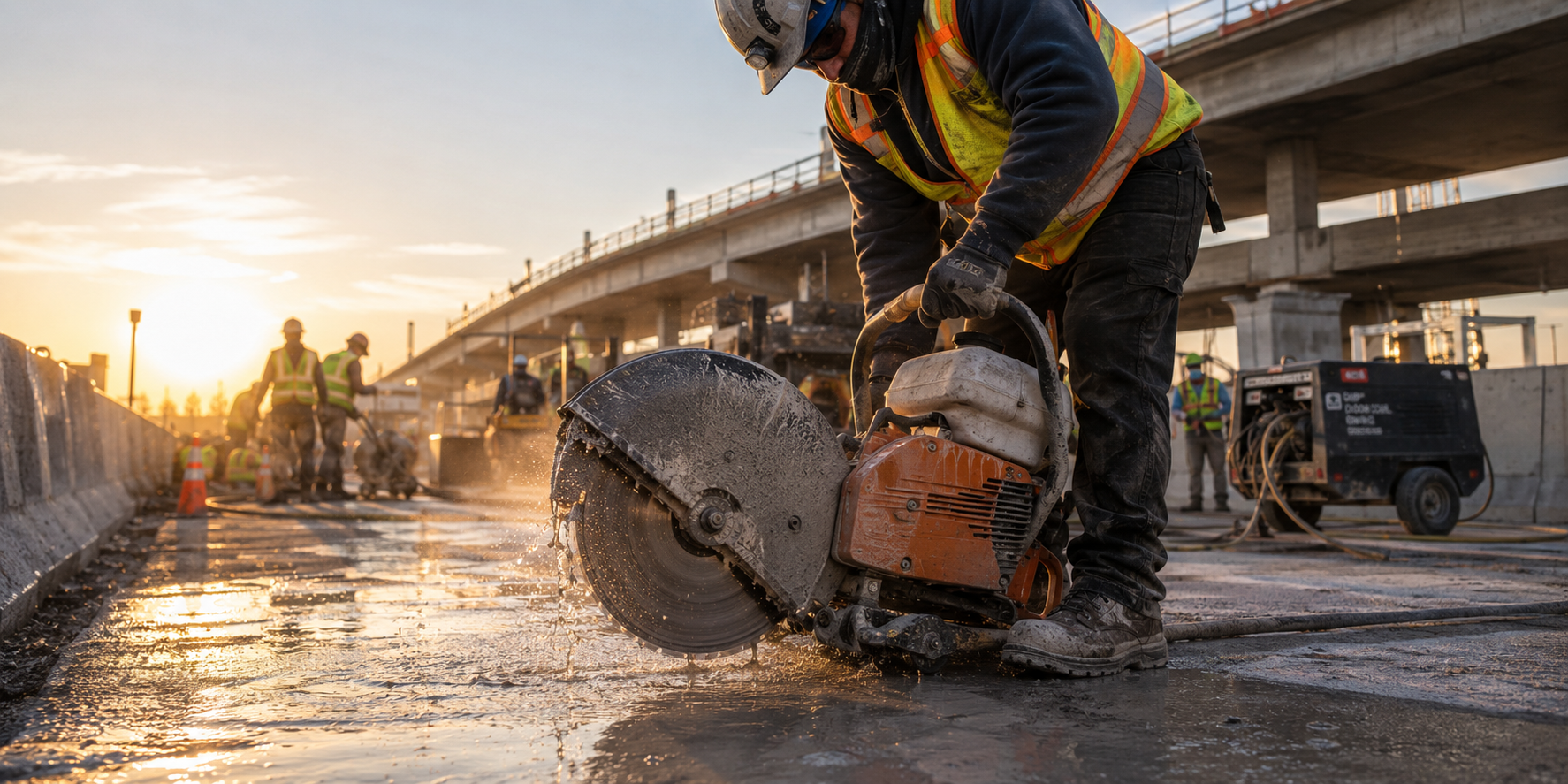
Utility work happens under traffic management, often at night, and almost always on a clock. Two things follow from that. First, carry spares — a blade change is minutes, a return visit is a whole shift and another closure. Second, cut wet wherever the machine allows, because slurry is easier to control on a live road than an airborne dust plume drifting into traffic.
Where a handheld saw has no water supply, a pressurised water bottle provides the continuous feed that OSHA Table 1 requires for cutting concrete without exposure monitoring.
What lives on the truck
Utility crews are rarely near a supplier when something is missing, so the stock list matters more than in most trades. A workable minimum: a hard-bond blade in your trench diameter plus one spare; a general purpose blade for incidental cutting; the two or three core sizes you fit most often; a pilot bit; and an arbor reducer bushing set so a blade that fits the job always fits the saw.
Keep blades flat and separated in a storage case rather than loose in the bed — a warped core cuts wide, wanders off the line, and cannot be straightened.
Frequently Asked Questions
What blade should I use for cutting a utility trench in asphalt?
A hard-bond segmented blade with undercut protection. Asphalt is abrasive and will strip diamonds from a soft matrix quickly, and the abrasive slurry attacks the core beneath the segments.
What size core bit do I need for a service penetration?
Order to the sleeve you will install rather than the pipe diameter. As a rough guide, 1 to 2 inches for conduit, 3 to 4 inches for waste and drainage, 5 to 6 inches for larger services, and 8 inches upward for structural or multi-service penetrations.
How deep will a walk-behind saw cut in one pass?
About a third of the blade diameter. A 20 inch blade reaches roughly 7 inches and a 30 inch blade about 10 inches. Size the blade to your trench depth before you order.
Can I core drill without a stand on utility work?
For small diameters in block or brick, yes, using a pilot bit to start the hole true. Larger barrels and anything through reinforced concrete generate torque that will twist the machine out of your hands, so use a stand.
How do I meet dust rules when there is no water on site?
Use a pressurised water bottle to give the saw a continuous integrated water feed, which is what OSHA Table 1 requires for handheld concrete cutting without exposure monitoring. On-tool extraction is the alternative.
Everything the trench crew needs on one order
Give us your typical trench detail and we will build the blade and bit list around it.
Talk to a Specialist