
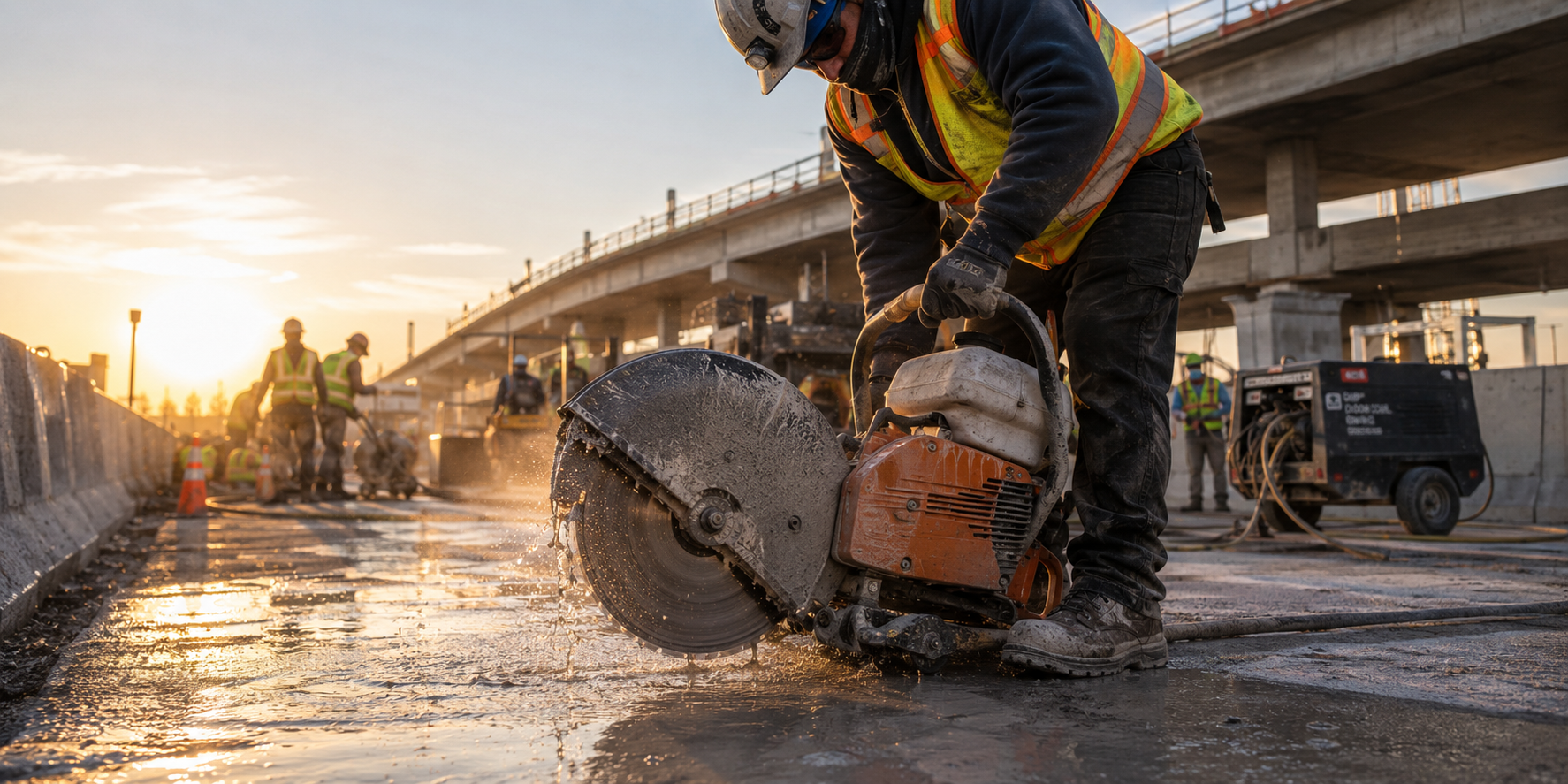
Diamond Tools for Bridge Contractors
Soft-bond blades that keep cutting through heavy reinforcement, wet core bits for anchors and drainage, and a realistic plan for the slurry before the first cut is made.
Deck concrete is defined by its steel
A bridge deck is not simply concrete — it is a dense, high-strength mix packed with reinforcement, often on tight centers and in two mats. That combination is exactly what glazes a blade chosen on price. Hard, dense material calls for a soft bond, so the matrix erodes at the rate the aggregate demands and keeps presenting sharp diamond.
Steel changes the feed rate whatever the blade. When the segments meet a bar, ease the pressure and let the blade work through rather than forcing the saw — forcing is what pulls segments off. The Pro Cured Concrete Blade is formulated to keep cutting through rebar-reinforced concrete, and our guide to cutting reinforced concrete sets out the technique in full.
Partial-depth removal and full-depth cuts
Most deck rehabilitation is partial-depth: saw the perimeter of the unsound area to a controlled depth, then break out to the top mat without nicking the steel you intend to keep. Cut depth control matters more here than raw speed, and the one-third-of-diameter rule still governs — a 14″ blade takes roughly 4-1/2″ in a pass.
Full-depth replacement panels are a different job, usually a walk-behind saw following a chalked boundary. What both share is that the sawn face is a construction joint the new pour has to bond to, so a clean, square cut is structural, not cosmetic. Blades for both live in the concrete blade range.
Anchors, drainage and instrumentation
Deck work generates a steady stream of penetrations: scupper and drainage openings, anchor holes for barrier rail and formwork, and cores for testing or instrumentation. Nearly all of it is through reinforced concrete, which means wet drilling with a segmented crown.
Anything much above 3″ in diameter belongs on a stand rather than in the hands — the stand holds the barrel perpendicular and absorbs the reaction torque that would otherwise be fighting the operator. The core drilling package pairs a motor, a stand and three barrels; individual barrels are in wet core bits.
The slurry is part of the job
Wet cutting is effectively mandatory on deck work — it buys blade life, controls silica, and on a structure it is often a permit condition. But water that has passed through a saw kerf is alkaline slurry, and on a bridge there is usually a watercourse directly below.
Plan containment before the saw starts: vacuum recovery, bunding at the deck edge, and a disposal route agreed with the client. It is far cheaper than an environmental incident, and inspectors increasingly ask to see the plan. Dust control and the wider exposure picture are covered in our OSHA Table 1 explainer.
Frequently Asked Questions
What blade should I use on a rebar-reinforced bridge deck?
A soft-bond segmented blade. Deck concrete is dense and high strength, and hard material needs a soft matrix that erodes fast enough to keep exposing sharp diamond. A hard bond will glaze and the saw will start pushing rather than cutting.
How deep can I cut in one pass on a deck?
About one third of the blade diameter. A 14 inch blade gives roughly 4.5 inches, an 18 inch blade around 6 inches. Step down for anything deeper rather than burying the blade.
Should bridge deck cutting be done wet or dry?
Wet. It extends blade life two to three times, controls respirable silica, and on most structures it is a permit condition. The trade-off is that you must have a slurry containment and disposal plan before you start.
Do I need a drill stand for deck coring?
For anything above about 3 inches diameter, or anything through reinforcement, yes. The stand fixes the drilling axis and takes the reaction torque, which is what makes larger diameters safe and produces a hole that is actually perpendicular.
Why do segments come off when cutting through rebar?
Usually because the operator forced the feed when the crown or rim met steel. Ease off and let the diamond work through the bar. Pushing harder loads the segment shoulder until it fails.
Tooling for deck work that has to pass inspection
Send us the deck detail and the reinforcement schedule and we will specify the blade.
Talk to a Specialist