Diamond Tools for Municipalities
A small crew, a fixed annual budget and a workload that runs from sidewalk repair to roadway patching. What you need is a short stock list that covers all of it.
A public works crew cuts everything
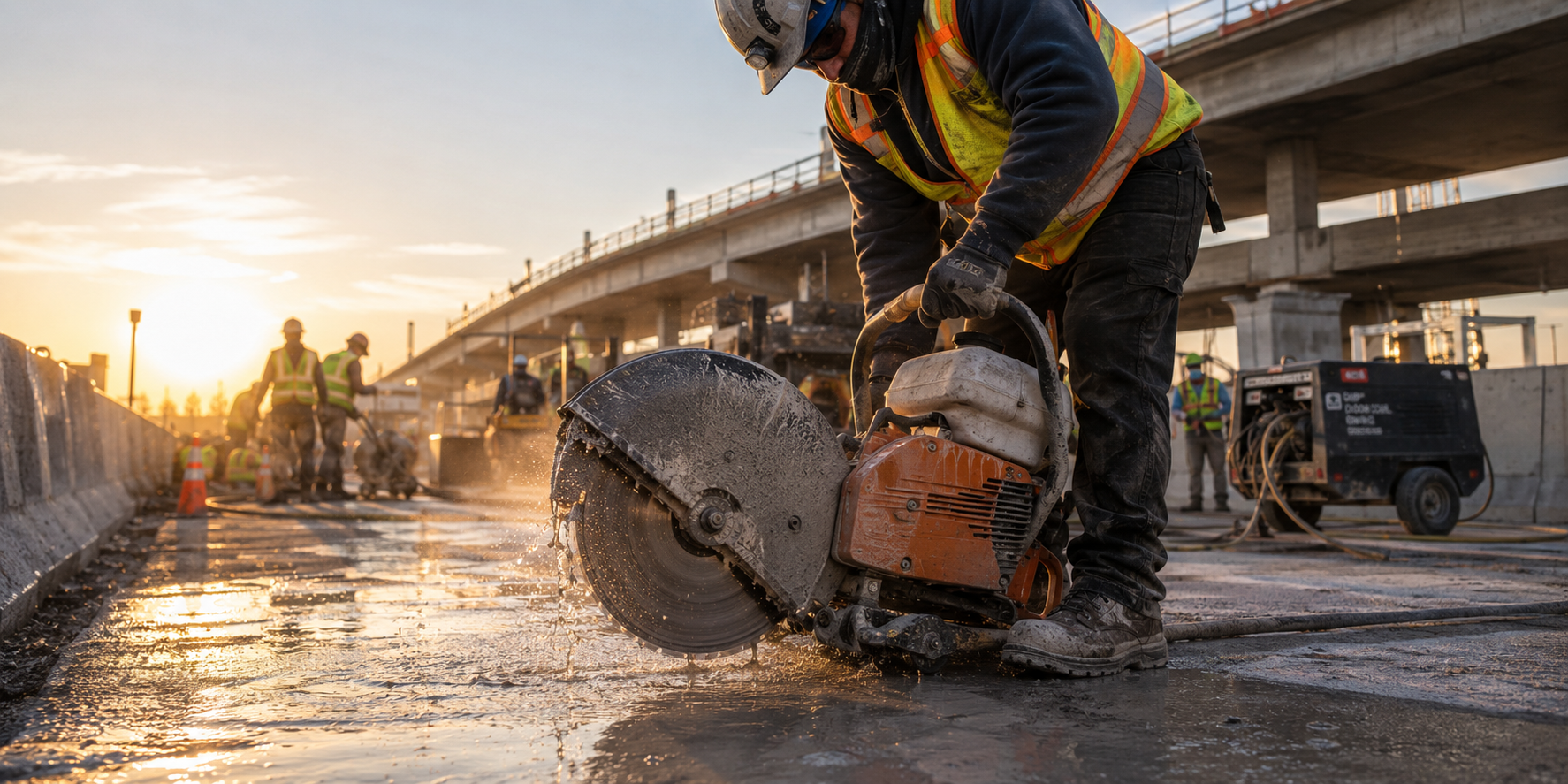
Unlike a specialist subcontractor, a municipal crew does not get to pick the material. In a single week the same saw might open a sidewalk panel, trim a curb, square up a pothole repair and cut a trench for a water connection. Concrete, asphalt, brick and block all in seven days.
That argues for a deliberately short stock list built around versatility rather than optimization: a medium-bond blade that works across concrete and asphalt, a hard-bond blade for the genuinely abrasive work, and a general purpose blade for everything incidental. Start with the Walk-Behind Pro for machine work and the All-Cut for the truck box.
Buying against a fixed annual budget
Procurement rules and a fixed budget make ad-hoc purchasing painful. The practical answer is to treat blades as a consumable with a known annual run rate, the way fuel and aggregate are treated, and buy them in volume once rather than one at a time as they fail.
A five-pack of 14″ concrete blades brings the unit cost down roughly 17% against single-blade pricing, which is a straightforward saving to justify on a requisition. Other volume options sit in contractor specials, and equipment bundles in blade and saw packages.
Silica compliance with a small crew
Public employers are held to the same silica standard as private contractors, and a small crew has less slack to absorb a monitoring program. The practical route is engineering controls: water at the blade or on-tool extraction, which under OSHA Table 1 removes the need for exposure monitoring on listed tasks.
For handheld cutting away from a hydrant, a pressurised water bottle supplies the continuous feed the standard asks for. A contractor safety kit covers the personal protection, but be clear that PPE supplements the controls rather than replacing them.
Owning versus hiring
Most public works departments own a walk-behind saw and a handheld cutter and hire anything larger. The calculation on core drilling is closer: past roughly a dozen jobs a year, owning the motor, the stand and a set of barrels usually beats hiring — and it removes the delay of arranging a hire for a two-hour job.
Where a department is equipping from scratch, the saw and blade package and the core drilling package cover the two most common gaps in one line item each, which also simplifies the paperwork.
One caution when equipping from scratch: buy the blades to match the work rather than the machine. A saw specified for 14″ will happily accept a cheap general purpose blade, and a crew that only ever fits that blade will conclude the saw is underpowered when the real problem is the bond. Set a standard specification for each of your three or four recurring jobs and write it into the stock list, so the right blade is the one that comes to hand.
Frequently Asked Questions
What blades should a public works department keep in stock?
A medium-bond segmented blade for mixed concrete and asphalt work, a hard-bond blade for abrasive asphalt and green concrete, and an economy general purpose blade for incidental cutting. Three specifications cover the great majority of municipal work.
Is it cheaper to buy blades in bulk?
Yes. A five-pack of 14 inch concrete blades works out about 17% below single-blade pricing. Because municipal blade consumption is fairly predictable year to year, buying to an annual run rate is straightforward to justify.
Do silica rules apply to municipal crews?
Yes. Public employers are held to the same standard. Using water at the blade or on-tool dust extraction on the tasks listed in OSHA Table 1 removes the requirement for exposure monitoring, which is the practical route for a small crew.
Should a municipality own or hire a core drill?
Past roughly a dozen coring jobs a year, owning generally wins, and it removes the delay of arranging a hire for a short job. Owning means the motor, the stand and the barrels together, because any one missing stops the work.
What size walk-behind blade suits municipal repair work?
Work from the depth you need to reach, at about a third of the blade diameter per pass. For typical sidewalk and roadway patch depths an 18 to 24 inch blade covers most work.
One stock list for the whole works yard
Tell us the jobs your crew covers and we will build a standing order that fits the budget.
Talk to a Specialist